To support an effective experience while doing an activity, we set out to build trustworthy audio guides for 33 of our 43 activities. The remaining 10 activities we outsourced to experts in their field to create video guides. For all 43 activities, this meant there would be no advertising, no teacher agendas, and no over-hyped promises to clutter up the session experience.
Each guide is built on the same set of essentials that ensure it works in practice. The instructions must be accurate for the specific activity, clear so that they can be implemented whether it’s the very first time trying it or you are deeply experienced in it, and the duration of the guide needs to be beneficial. These essentials create a base guide and from there we adapt it to useful variations.
For example, every base guide is available in both text and audio variations. Some days you might want to read a text version beforehand so you can be hands-free and focused once you begin. Or read as you go. Other days you might prefer to be talked through it, with clear verbal guidance every step of the way. That choice gives the flexibility to approach each activity in the way that works best for you.
After creating this base guide, we also considered communication style, because delivery shapes how communication is received.
We all respond to different communication styles. Some people value directness and honesty, the competent no-nonsense voice that tells it straight and rewards effort. Others prefer a more considerate and gentle approach, and value the warmth that comes from that.
Research has shown that people instinctively tune in to two main things in communication: warmth and competence**.** People perceived as warm and competent elicit positive feelings and behaviours, while those lacking these qualities elicit negativity (Fiske et al., 2006). These findings have been widely replicated and continue to hold up in current research; social psychologists consider warmth and competence “universal dimensions of social perception” because they show the same effects consistently across cultures and contexts (Dupree & Fiske, 2017).
Sometimes we lean toward a voice that feels caring and supportive. Other times it is the confident and competent voice that we prefer. Both can be useful, depending on your preferences or what you need in the moment.
When the words and tone are right, they help you lean in and find the gears for a solid session. When they’re off, you might switch out early. Because of this, we knew we didn’t want anyone locked into a single tone or style when using a guide.
We first tried inventing characters, but names, backstories, and personalities were not the point. What was crucial was simply the style of communication. From that realisation, we honed in on the following three distinct styles.
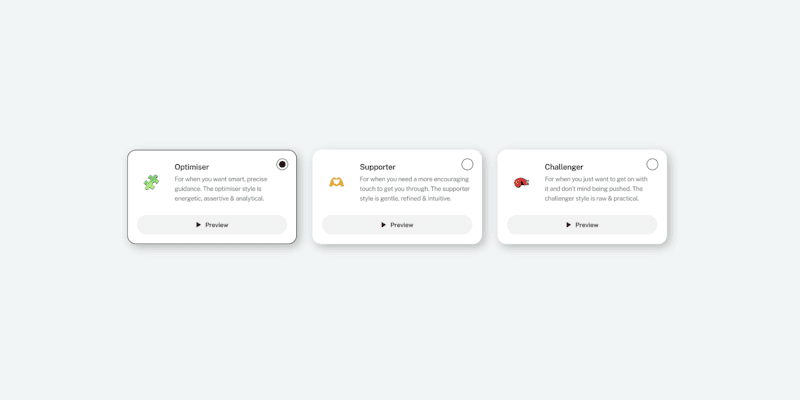
Optimiser
Think perceptive and curious. The Optimiser sounds like a well-read expert voice who can help you see familiar things in a new way. The language is modern and polished without slipping into cliché. This style is a good fit when you want a more analytical perspective and clear framing as you move through the steps.
Supporter
Warm and encouraging, the Supporter feels most like a trusted coach by your side. You will feel that you are not alone and that you are being helped through the session. It is the right fit when you want encouragement and practical help without vague language.
Challenger
The Challenger leads with being direct and bold, tells it to you straight and keeps you moving. This style works well when you are not up for fussy or flowery language and you do want clarity, a definite next step, or you need that bit of heat!
Behind the voices
When you listen to a Bearmore guide, what you hear is built from real human voices. We opted to use text-to-speech technology. Choosing the best fit voice for each guidance style is another piece that helps to bring that communication style to life.
Using text-to-speech technology also makes it possible to keep producing new guides, to expand the selection available, and to maintain a consistent level of quality from one guide to the next.
Because the starting points are real human voice actors, the guides already sound natural. Even so, some parts are still challenging. Pacing and presence are the hardest to capture, and they can make a difference in how a guide feels. These are areas where the technology is moving quickly, and we continue to experiment as it improves.
What this means in the app
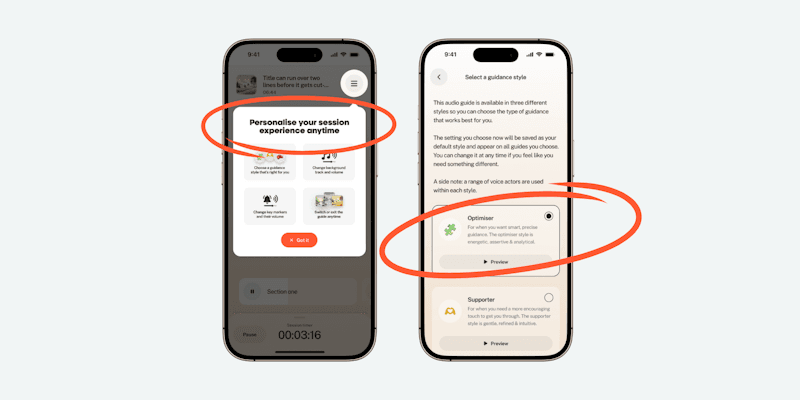
Every audio guide can be experienced in any of the three styles. You choose the guidance style that suits you best. That personal decision might shift day to day, or even session to session.
Sometimes the choice is about the activity itself, how you feel about it, and what you need when you're doing it. A cold plunge, for example, might call for the Challenger, giving you direct, no-nonsense direction to get it done. A meditation might feel more accessible with the Optimiser, where precise language helps you understand exactly what you are doing.
Other times, the choice is about where you are personally in that moment. If you are tired, scattered, or stressed, the right guidance style might make the difference between a session that works for you and one that misses the mark.
This flexibility is built into the app. You can preview each style before you begin, set a default style that will appear across all guides, anytime you start a guided session. You can also change styles at the start of any new session or even mid-session without needing to restart. Your preferred current settings are always visible alongside other personalisation options, like background tracks or timing markers.
The activity itself will always maintain the same set of instructions, but the communication style can make the difference in the way you experience it.
Looking ahead
Guidance at Bearmore is built for flexibility. The voices, styles, and formats will keep evolving as technology advances and as we learn more about what works best based on user feedback. The aim is clear: to make it easier to step into an activity and stay with it.